

Senior Health

Dementia and Incontinence: 7 Tips to Help

If dementia and incontinence are causing challenges for someone you love, these tips can help.
Dementia care necessitates both compassion and creativity to deal with a number of complex behaviors and effects, and that’s particularly true when someone is experiencing both dementia and incontinence. Unfortunately, incontinence occurs frequently in Alzheimer’s as well as other forms of dementia. These tried-and-true approaches from our experts in home care in Marin and the surrounding areas can help decrease the impact of incontinence and prevent an escalation of emotions in someone you love with Alzheimer’s.
Choose your words very carefully. Rather than making reference to incontinence products as “diapers,” for example, call them “briefs” or “pull-up underwear.” Nonetheless, take the cue from your senior loved one; if she or he chooses to utilize the word “diapers” and seems more comfortable with that, then … Read More »

Add This to Drinking Water to Potentially Fight and Prevent Hypertension

This one simple addition to your next glass of water may just prevent hypertension.
Great news for the more than 116 million Americans who are fighting hypertension – and, for the rest of us who’d like to prevent hypertension. Recent studies shared in the Journal of the American Heart Association link calcium and magnesium to lowered blood pressure, and it might just be as easy as adding a certain combination of minerals to drinking water to benefit the entire population.
The surprising results of the research uncovered that those who drank salinated water, compared to those who drank fresh water, experienced lower blood pressure levels – believed to have been the result of the positive benefits of calcium and magnesium outweighing the negative effects of the sodium.
And though the resulting lowered blood pressure readings were small, Dr. … Read More »
5 Ways to Calm Agitation in Alzheimer’s

Agitation in Alzheimer’s is common but can be eased with these tips.
Agitation in Alzheimer’s is one of the more difficult effects a senior may experience, and it can be incredibly hard for family members to manage. The key is in taking steps to handle agitation before it’s felt and expressed by the senior, which involves keeping track of what has brought about these feelings in the past, and creating a home environment in which those triggers are removed or minimized. These strategies can help:
Designate an area of retreat. When life begins to get stressful, having a specially created area for a senior loved one to go to de-stress can work wonders in restoring calm. This could be a separate room, or merely a comfortable corner with several soothing activities easily available, quiet music, a calming scent to … Read More »
How to Approach Money Management Issues With Seniors

Money management issues with seniors need to be addressed tactfully and with sensitivity.
Among the most difficult obstacles for older adults is recognizing the need for help with financial matters. Finances are both extremely personal and a representation of your autonomy, and adult children specifically can often be met with opposition when stepping into this arena when suspecting money management issues with seniors.
However, for a number of reasons, including the ever-increasing incidence of senior scams and cognitive decline, it’s essential to make sure that the financial assets our senior loved ones have acquired through the years are safeguarded, and that bills are paid correctly and on time. It’s an issue that needs to be taken care of delicately and with diplomacy. Try these strategies for an easy transition to assisting a loved one with monetary management:
The introductory … Read More »
Tips on How to Help Someone With Alzheimer’s Through Reminiscence Therapy

Discover how to help someone with Alzheimer’s in a simple and unique way: reminiscence therapy.
Did you ever experience that jolt of a past memory that immediately pops to the front of your mind, perhaps through a scent, a song, or a picture? For those with dementia, the power of long-term memories is especially impactful, as short-term memory becomes weaker. And if you’re looking for ideas on how to help someone with Alzheimer’s, tapping into this idea is a great place to start. In fact, it’s become a growing trend in creative Alzheimer’s care: reminiscence therapy.
One extreme example is the transformation of a 9,000-sqft building in Chula Vista, California. The building is now an interactive 1950s town, including storefronts like a diner, a movie theater, and a healthcare clinic, all operating just as they would have been … Read More »
Overcome Senior Isolation and Loneliness with These Tips
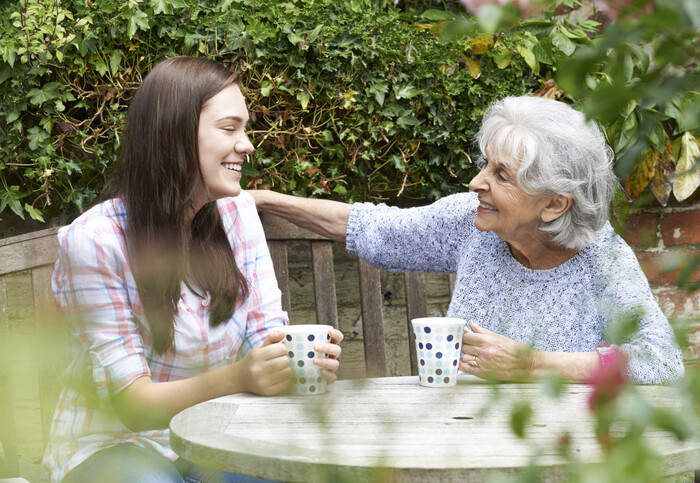
We know that socialization is vitally important for our overall emotional (and even physical) wellbeing – but we also know that senior isolation and loneliness is an epidemic in America. With the hectic pace of life, it’s difficult for families and friends to provide the full measure of social interaction needed to keep loneliness at bay for older adults, who are often homebound or unable to get out as much as they’d like.
But the mother of invention truly is necessity, and the need for creative socialization solutions has sparked some interesting innovations:
The Chat Bench
Thanks to the police department in the southwest England town of Burnham-On-Sea, several benches now boast signage that boldly proclaims, “The Happy to Chat Bench: Sit Here if You Don’t Mind Someone Stopping to Say Hello.” And, stop they do! It’s a lovely … Read More »
4 Important Facts About Cancer You May Not Know

These facts about cancer may change the way you think about the disease.
Each year since 1999, we’ve achieved an increasing decline in cancer-related deaths, an encouraging trend that’s poised to continue as researchers learn more and more facts about cancer and its causes, and are able to develop new and better treatment methods. Yet cancer is still one of the leading causes of death in America, second only to heart disease – making it all the more crucial to continue to press forward with persistence to find a cure.
Here’s what we’ve learned so far:
Diet makes a difference. Although a diet rich in antioxidants can help prevent cell damage (and protect against cancer), a recent study showed that in some cases, cancers take advantage of a nutrient-rich diet, leading to accelerated metastasis. As a result, the recommendation … Read More »
Women and Alzheimer’s: Why the Risk Is So Much Greater and How to Help
Understand the trend between women and Alzheimer’s and discover how you can help someone you love who is battling the disease.
Researchers are finally beginning to get a grip on the imbalance between Alzheimer’s diagnoses in women and men. Currently, as many as 2/3 of those with Alzheimer’s in the U.S. are female. As scientists begin to understand the particular nuances behind the increasing trend of women and Alzheimer’s, we can begin to address the problem and find solutions.
According to the Alzheimer’s Association’s Director of Scientific Engagement, Rebecca Edelmayer, “Women are at the epicenter of Alzheimer’s disease as both persons living with the disease and as caregivers of those with dementia. Over the last three years, the Alzheimer’s Association has invested $3.2 million into 14 projects looking at sex differences for the disease and some of the … Read More »
Avoid These 5 Ways That Worsen the Symptoms of Alzheimer’s
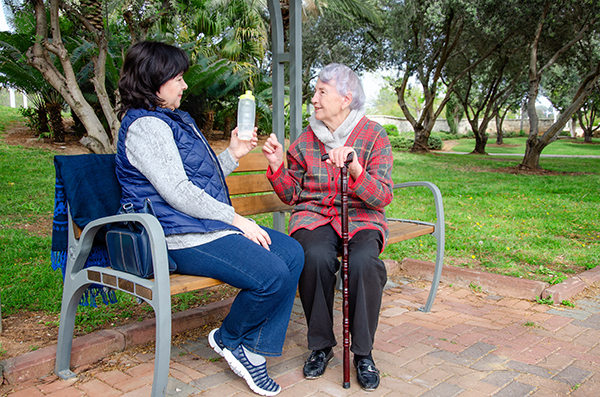
It’s important to be aware of several key triggers that can worsen the symptoms of Alzheimer’s.
While there are a number of commonalities, the symptoms of Alzheimer’s can impact each individual differently. Our highly trained dementia caregivers know, for instance, that while one person may appreciate being outdoors, another may be overwhelmed by so much sensory input and prefer a quieter indoor environment. One may appreciate a morning bath routine, while a dose of resourcefulness is necessary to help a different individual maintain good hygiene.
We also realize there are certain triggers that may often worsen the challenging aspects of Alzheimer’s disease. Family care providers should be particularly careful to avoid the following:
Dehydration. Someone diagnosed with dementia might not be able to identify when they are thirsty, or may refuse when offered fluids. It’s vital to ensure appropriate … Read More »
Warning: These Common Medications May Increase Dementia Risk

Certain medications may now be linked to an increased dementia risk.
They are currently recognized to cause various short-term side-effects, for example, memory issues and confusion, but new research links some of the stronger anticholinergic drugs (like those prescribed for Parkinson’s disease, epilepsy, depression, and overactive bladder) to a markedly higher dementia risk.
The research involved two groups of seniors: 59,000 patients with dementia, and 225,000 without. Approximately 57% of those with dementia, and 51% without, were supplied a minimum of one (and up to six) potent anticholinergic medications. Considering other established dementia risk factors, the outcomes were an astounding 50% increased risk of dementia in individuals who were taking strong anticholinergics daily for three or more years, with the highest risk to people who received a dementia diagnosis before age 80.
It is critical to note that … Read More »