
Senior Health

How to Care for Someone With a Progressive Disease
These tips will guide you in how to care for someone with a progressive disease.
It might have been expected, or perhaps broadsided you without warning. Mom has just received the official diagnosis for a progressive disease that is likely to make independent life difficult. While there are a number of uncertainties, one thing is for sure: she is adamant about remaining at home – meaning you’ll have to learn how to care for someone with a progressive disease.
Welcome to the world of family caregiving! If you’re feeling a bit overwhelmed with what can be expected next, these recommendations will help.
Discover as much as you’re able to about the disease. The older adult’s doctor can provide you with resources and educational materials to help you know what to anticipate and to gain confidence in your caregiving role.
Prioritize … Read More »

4 Ways to Boost Resilience in Older Adults
Discover how to improve resilience in older adults in four simple steps.
Did you ever encounter someone so inspiring that it completely changed your viewpoint on life? It might lead you to pause and wonder what it is about that person that supplies them with the drive and strength to stand out from the crowd. This type of resilience in older adults is especially encouraging, showing us that whatever comes our way, at whatever age, life is beautiful, rich, and fulfilling.
At the Robert N. Butler Columbia Aging Center at Columbia University, research workers decided to examine this further with their “Exceeding Expectations” project. They followed 20 elderly New Yorkers from diversified backgrounds and cultures for a two-year time period. Here is what they learned about the resiliency of these extraordinary individuals.
They never let their obstacles define them. … Read More »
Help Seniors Live Longer and Better Through Finding a Sense of Purpose

Learn how to help seniors live longer and better with these tips.
What inspires you to get up out of bed every morning? The answer is different for every one of us, of course, but there’s one commonality: it could extend your life. Scientific studies are showing us that having a feeling of purpose is a key way to help seniors live longer and better, something evidenced in Japan – the country with the highest life expectancy on earth.
Remarkably, there is no word for our definition of “retirement” in the Japanese language. There is, instead, a concentration on maintaining purpose and meaning beyond a person’s working years and defining themselves according to their current passions and pastimes.
So just how can we help older adults – and ourselves – stay involved in what sparks interest and makes … Read More »
Separate Truths From Myths About Hospice Care

Learn some of the most common myths about hospice care and the true facts about this incredibly beneficial form of care.
If you knew that a significantly better quality of life could be achieved for someone you care about, you would not think twice about exploring that option. Yet one of the most beneficial forms of care – hospice – is one that family members shy away from, due to many different misperceptions and myths about hospice care.
Hospice is meant to help someone with a life-limiting illness find respite from pain and other difficult symptoms, while obtaining comfort as well as spiritual and emotional support. Hospice care is provided night and day, both for the individual needing care as well as family members. And, for anyone covered by Medicare, hospice care is offered for a very low … Read More »
How to Overcome Sleeping Problems in Dementia

Try these tips to help someone experiencing sleeping problems in dementia get a better night’s rest.
If it seems like a senior with dementia has completely rewritten the rules on when and how to sleep, you’re not dreaming. For reasons that aren’t yet fully understood, sleeping problems in dementia are quite common. Changes to the senior’s circadian rhythm lead to drowsy days and sleepless nights.
The development of the disease is one contributing factor. Damage to brain cells causes increased weakness, making everyday tasks and activities exhausting. Medication side effects from commonly-prescribed dementia treatments can further exacerbate the issue.
Why Is a Good Night’s Sleep Crucial for a Loved One with Alzheimer’s?
Decreased sleep quality in dementia may bring about an increase in restlessness and delusions, and can cause serious safety concerns, such as the potential for an … Read More »
How to Tell the Difference Between Dementia and Medication Side Effects
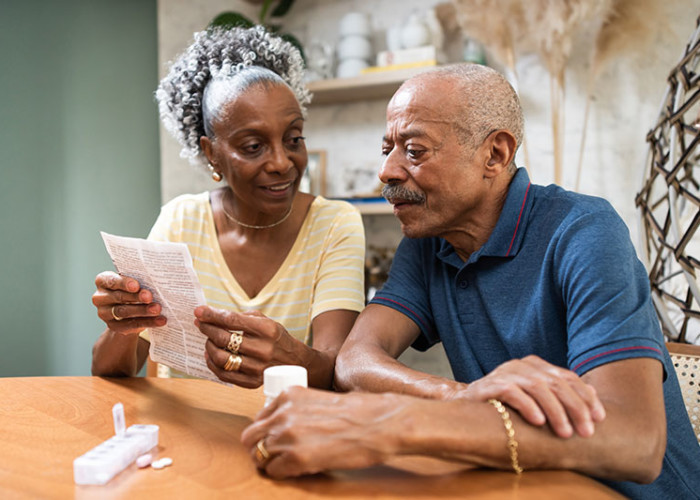
With so many similarities, can you tell the difference between dementia and medication side effects?
Disorientation. Confusion. Memory loss. While these are certainly hallmark symptoms of Alzheimer’s disease and other types of dementia, they may also come about from taking certain medications. Before automatically assuming an inevitable diagnosis of dementia, review the following list of prescribed medicines that can cause similar adverse effects in order to help tell the difference between dementia and medication side effects.
The Latest Surprising Facts About Alzheimer’s

The latest surprising facts about Alzheimer’s are changing the way scientists are thinking about what causes the disease.
Surprising facts about Alzheimer’s are surfacing nearly every day, it seems. Take, for instance, amyloid plaques: they’re at the heart of scientists’ hypotheses about what causes Alzheimer’s, and the focus of research is on removing them as an effective treatment option and hopefully, one day, a cure.
Yet a research study led by the University of Cincinnati and in cooperation with the Karolinska Institute in Sweden is turning this thinking upside down. Alberto Espay, the study’s senior author and professor of neurology at UC, shares, “It’s not the plaques that are causing impaired cognition. Amyloid plaques are a consequence, not a cause.”
If Not Amyloid Plaques, Then What?
Espay and the UC team believe the focus should instead shift to … Read More »
The Benefits of a Daily Routine for Seniors

ry implementing a daily routine for seniors who are struggling with physical or cognitive functioning problems.
Life can be full of uncertainties. For seniors who are feeling less in control of particular areas of life, such as losing cognitive or physical functioning, concentrating on what can be controlled is empowering. An excellent way to help is by establishing a daily routine for seniors, personalized to a senior’s particular interests and needs.
Keep in mind that the older adult’s routine is certainly not meant to be a rigid regimen to be adhered to, but simply the basis for predictability and structure. With the older adult’s input and direction, settle on a preferred framework for every day. A sample daily routine may look like this:
Wake up at 7:30 a.m.
Handle personal hygiene needs and get dressed
Enjoy breakfast on the porch while … Read More »
The Harm in Talking to the Elderly Like Babies

We all need to understand how disrespectful talking to the elderly like babies is, and to avoid this common practice.
Watch what happens at the next family members get together when a new mother places her baby in someone’s arms. The person is likely to shift instantly into baby mode: a sing-song, high-pitched voice, exaggerated facial expressions, and overly-simplified speech. Of course, this is quite normal and actually beneficial to an infant’s growing brain. Sadly though, it is also quite common to hear people talking to the elderly like babies too. This can be so harmful to the elderly, that there’s a word to describe it: elderspeak.
A recent research study by Susan Kemper, a professor specializing in gerontology at the University of Kansas, matched senior listeners with younger speakers. Even with the seniors’ instructions just to listen … Read More »
Concerned It Might Be Dementia? Here’s How to Bring It Up to the Doctor.

You may be afraid to talk with the doctor if you’re concerned it might be dementia, but these tips can help.
Distress. Embarrassment. Fear. If you’re concerned it might be dementia, the feelings surrounding a potential diagnosis can force you to keep your suspicions to yourself. An AARP survey peeled away some of the layers of emotion to find the reason – namely, worry over losing independence and becoming a burden to others.
While there is some truth to these worries, there are also some misconceptions fueling them. As an example, roughly 1/2 of the participants, who were adults age 40 and over, believe they’re likely to get dementia as they grow older. The truth is that just over 10% of older adults over age 65 are identified as having Alzheimer’s disease.
Because of this, it’s critical for … Read More »