

Senior Independence

Dementia and Incontinence: 7 Tips to Help

If dementia and incontinence are causing challenges for someone you love, these tips can help.
Dementia care necessitates both compassion and creativity to deal with a number of complex behaviors and effects, and that’s particularly true when someone is experiencing both dementia and incontinence. Unfortunately, incontinence occurs frequently in Alzheimer’s as well as other forms of dementia. These tried-and-true approaches from our experts in home care in Marin and the surrounding areas can help decrease the impact of incontinence and prevent an escalation of emotions in someone you love with Alzheimer’s.
Choose your words very carefully. Rather than making reference to incontinence products as “diapers,” for example, call them “briefs” or “pull-up underwear.” Nonetheless, take the cue from your senior loved one; if she or he chooses to utilize the word “diapers” and seems more comfortable with that, then … Read More »

Tips to Make the Most From Family Senior Care Meetings

Make family senior care meetings more productive and efficient with these tips.
“It takes a village” was never a more accurate statement than when taking care of an older family member. It’s important for that “village” to have effective, ongoing communication so that you can offer the best care and to make sure everyone taking part in that care is on the same page. It’s also critical for family caregivers to have the opportunity to express concerns and to come together to get to resolutions, to share various perspectives, and to continue to be proactive in preparing for the future.
Holding senior family care meetings that produce good outcomes includes thinking through the following:
Who should always be included – and who should not? Unquestionably, those providing direct or indirect care for the senior loved one should attend, as … Read More »
Senior Finances: Help Prepare for Future Needs Now

Get a grip on senior finances and plan for future needs today with these tips.
The good news is we’re now living longer than ever before, with upwards of one in three older adults living until age 90 and beyond. The bad news, however, is that retirement planning for today’s seniors often didn’t take into consideration such longevity, leading to a strain on senior finances in later years.
So, what happens if your parents outlive their financial resources? As part of the sandwich generation, making their own retirement plans while still covering expenses for your own children, you may find yourself in need of supporting your aging parents as well. As a matter of fact, a recent survey by AgeUp shows that:
Nearly three out of four participants believe that at least one of their parents will live longer … Read More »
Tips on How to Help Someone With Alzheimer’s Through Reminiscence Therapy

Discover how to help someone with Alzheimer’s in a simple and unique way: reminiscence therapy.
Did you ever experience that jolt of a past memory that immediately pops to the front of your mind, perhaps through a scent, a song, or a picture? For those with dementia, the power of long-term memories is especially impactful, as short-term memory becomes weaker. And if you’re looking for ideas on how to help someone with Alzheimer’s, tapping into this idea is a great place to start. In fact, it’s become a growing trend in creative Alzheimer’s care: reminiscence therapy.
One extreme example is the transformation of a 9,000-sqft building in Chula Vista, California. The building is now an interactive 1950s town, including storefronts like a diner, a movie theater, and a healthcare clinic, all operating just as they would have been … Read More »
Overcome Senior Isolation and Loneliness with These Tips

We know that socialization is vitally important for our overall emotional (and even physical) wellbeing – but we also know that senior isolation and loneliness is an epidemic in America. With the hectic pace of life, it’s difficult for families and friends to provide the full measure of social interaction needed to keep loneliness at bay for older adults, who are often homebound or unable to get out as much as they’d like.
But the mother of invention truly is necessity, and the need for creative socialization solutions has sparked some interesting innovations:
The Chat Bench
Thanks to the police department in the southwest England town of Burnham-On-Sea, several benches now boast signage that boldly proclaims, “The Happy to Chat Bench: Sit Here if You Don’t Mind Someone Stopping to Say Hello.” And, stop they do! It’s a lovely … Read More »
Women and Alzheimer’s: Why the Risk Is So Much Greater and How to Help

Understand the trend between women and Alzheimer’s and discover how you can help someone you love who is battling the disease.
Researchers are finally beginning to get a grip on the imbalance between Alzheimer’s diagnoses in women and men. Currently, as many as 2/3 of those with Alzheimer’s in the U.S. are female. As scientists begin to understand the particular nuances behind the increasing trend of women and Alzheimer’s, we can begin to address the problem and find solutions.
According to the Alzheimer’s Association’s Director of Scientific Engagement, Rebecca Edelmayer, “Women are at the epicenter of Alzheimer’s disease as both persons living with the disease and as caregivers of those with dementia. Over the last three years, the Alzheimer’s Association has invested $3.2 million into 14 projects looking at sex differences for the disease and some of the … Read More »
Avoid These 5 Ways That Worsen the Symptoms of Alzheimer’s
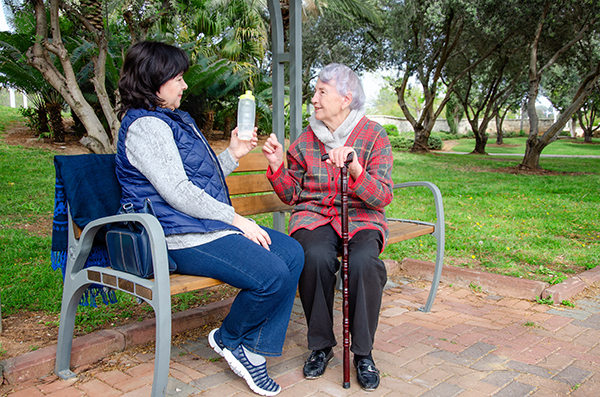
It’s important to be aware of several key triggers that can worsen the symptoms of Alzheimer’s.
While there are a number of commonalities, the symptoms of Alzheimer’s can impact each individual differently. Our highly trained dementia caregivers know, for instance, that while one person may appreciate being outdoors, another may be overwhelmed by so much sensory input and prefer a quieter indoor environment. One may appreciate a morning bath routine, while a dose of resourcefulness is necessary to help a different individual maintain good hygiene.
We also realize there are certain triggers that may often worsen the challenging aspects of Alzheimer’s disease. Family care providers should be particularly careful to avoid the following:
Dehydration. Someone diagnosed with dementia might not be able to identify when they are thirsty, or may refuse when offered fluids. It’s vital to ensure appropriate … Read More »
Take These Steps to Prevent Financial Elder Abuse

Protect the seniors you love from financial elder abuse with these tips.
When asked whether they thought they might be at risk for financial elder abuse or fraud, the overwhelming majority of surveyed older adults – 81%, in fact – were confident that they would never fall for a scam. We all want to believe we’re too savvy and smart to be taken advantage of; but the reality is, many scammers are even smarter and savvier.
And though we might assume that financial fraud mostly occurs at the hands of strangers, the truth is that as many as two out of three of all financial crimes are committed by people the victim knows and trusts.
The good news is, there are several steps that seniors and their loved ones can take to protect themselves:
Register with EverSafe (or a … Read More »
How to Empower Seniors to Take Control for Better Chronic Health Care

Seniors know best what they’re dealing with; empower them to take control of their chronic health care needs.
When it comes to chronic health care, seniors are the experts, hands down, with up to three out of four seniors affected by a number of conditions that are ongoing, necessitate long-term medical treatment, and place restrictions on activities. With the never-ending barrage of bloodwork as well as other tests, physicians’ appointments and procedures, and medications, managing chronic diseases usually takes both a physical and emotional toll, and may quickly become daunting.
Dr. Mary Tinetti, chief of geriatrics and internist at Yale School of Medicine, said, “Once you get three, four, or five and six diseases, several things happen: Number one, almost guaranteed, trying to get one of these diseases under control is going to make one of the other … Read More »
How Artificial Intelligence Is Playing a Key Role in Alzheimer’s Research

Learn about the tool that’s helping expedite Alzheimer’s research.
Alzheimer’s research took a giant leap forward, thanks to a tool that allows pathologists to analyze and classify amyloid plaques and abnormalities in blood vessels through technology similar to face recognition software – leading to the ability to process a vast amount of data in a markedly reduced amount of time.
The study, conducted by UC Davis and UC San Francisco, tested the ability to automate the time-intensive process of reviewing, identifying, and analyzing microscopic amyloid plaques in brain tissue. Dubbed “blob or not,” this digital pathology tool was found to be highly efficient – correctly annotating plaque samples at the unimaginable rate of 2,000 per hour – limited only by the number of processors used in the study. The program was even able to distinguish between different types … Read More »