

Senior Medical Care

Not All Alzheimer’s Diagnoses Are the Same!

Alzheimer’s is increasingly common in older adults, but not all Alzheimer’s diagnoses are the same!
For many years, experts have been examining the advancement of Alzheimer’s through one basic model. Yet not all Alzheimer’s diagnoses are the same, presenting with a variety of symptoms and progression rates.
Now, however, a large, new collaborative study between the US, Canada, Sweden, and Korea is revealing some fascinating information to help us more accurately understand and treat Alzheimer’s disease. Rather than one universal, dominant diagnosis of Alzheimer’s, researchers have discovered that there are four unique variants that occur in as many as 18 – 30% of cases. This change in thinking is helping researchers more fully comprehend the variations in the disease from one person to another.
The findings are also significant in that they are allowing specialists to begin to … Read More »

Are the Older Adults You Love Missing Out on These Life-Changing Adaptive Tools?

As many as half of all seniors living at home are not utilizing life-changing adaptive tools.
Consider the many tools you make use of each day – your phone, toothbrush, hairbrush – simple items, but ones you can’t imagine living without. For many seniors, there are basic but life-changing adaptive tools available that could mean the difference between living at home and facing a move to assisted living. Yet almost 50% of seniors living at home are not utilizing these helpful tools – even though costs are minimal.
A recent National Health and Aging Trends Study assessed the ability of older adults to execute tasks such as rising unassisted from a sitting position and walking, and discovered that a large number of the participants could benefit from assistive devices.
Not only that, but the likelihood of older adult … Read More »
The Post-Pandemic Health Care Appointments You Should Schedule Today

Learn about three post-pandemic health care appointments you may have been putting off, and why you should get them scheduled.
At the start of the pandemic, life as we knew it came to a screeching halt – including, in many cases, our health care needs. Dr. Ned Sharpless, director of the National Cancer Institute, shares, “There was a time, early in the pandemic, when we didn’t know much about this virus. So at that time, I think hospitals and clinics closing – that made sense.” But he goes on to explain that we know more now – and now is the time to get back on track with post-pandemic health care appointments and procedures.
We have evidence now that the health risks of avoiding exams and tests outweighs the risk of contracting COVID-19. Experts have outlined three key … Read More »
What Can I Expect as Dementia Progresses?

If you’re asking yourself, “What can I expect as dementia progresses?” we have the information you need.
One of the first questions in most people’s minds when a loved one is diagnosed with dementia is, “What can I expect as dementia progresses in the weeks, months, and years to come?” We understand that the hallmark of dementia is the increasing decline in cognitive abilities as well as the skills needed to manage daily life. However, each person progresses through these changes at a different pace. There are a variety of factors that will influence the rate of decline, such as:
Prescription drugs the individual is taking
Overall health and physical makeup
The circle of support in place
The individual’s general emotional wellbeing and resilience
There are also other determinants to take into account based on the specific type of dementia diagnosed. As … Read More »
The Surprising Sense of Awareness in End-Stage Dementia and What It Means

Someone you love may experience a heightened sense of awareness in end-stage dementia, which can be both surprising and overwhelming.
Even as confusion and memory loss escalate during the advancement of dementia, there’s a fascinating and pleasant reprieve that often occurs. Formerly termed “terminal lucidity,” it is more commonly known as “paradoxical lucidity.” It signifies an unexpected, short-term regaining of clarity and awareness in end-stage dementia to a nearly pre-dementia frame of mind. During this time period, the effects can consist of nonverbal but emotional connections to a more drastic improvement in cognitive functioning.
For loved ones, it’s a special gift to be cherished. It offers an opportunity for meaningful conversations and reminiscing, and also the mutual sharing of feelings and thoughts, if only for a brief period of time. For medical researchers, it means much more.
Dr. … Read More »
COVID-19 Delirium and Dementia: Is There a Link?

Find out what experts are saying about a possible link between COVID-19 delirium and dementia.
Just one of the numerous negative effects from COVID-19 is temporary delirium. As a matter of fact, two separate studies revealed that 55% – 65% of individuals who were severely ill from the virus experienced the acute confusion that is one of the trademarks of delirium – as compared to approximately 33% of those critically ill with other health conditions. And while it may be short-lived, the long-term effects are still being determined, including a possible link between COVID-19 delirium and dementia.
Understanding Parkinson’s Fatigue: It Feels Like “Walking Through Molasses”

Parkinson’s fatigue affects a person cognitively, physically, and emotionally.
Parkinson’s fatigue affects as many as one in two people with the disease, but until recently, we haven’t fully understood just how debilitating this condition actually is. A study is providing us with the insight we need to comprehend the impact of Parkinson’s fatigue, and what we can do to help someone experiencing it. Led by Duke University’s Sneha Mantri, MD, the goal of the research was to gain firsthand patient insights to know how to better address this challenging condition.
Three distinct areas of fatigue were investigated in the study: physical, emotional, and cognitive. Participants were asked to describe their level of fatigue, and the terms they used were quite revealing, including feeling unmotivated, overwhelmed, isolated, lacking energy, and as if they were “walking through molasses.”
Parkinson’s fatigue … Read More »
5 Tips for Rummaging Behaviors in Dementia
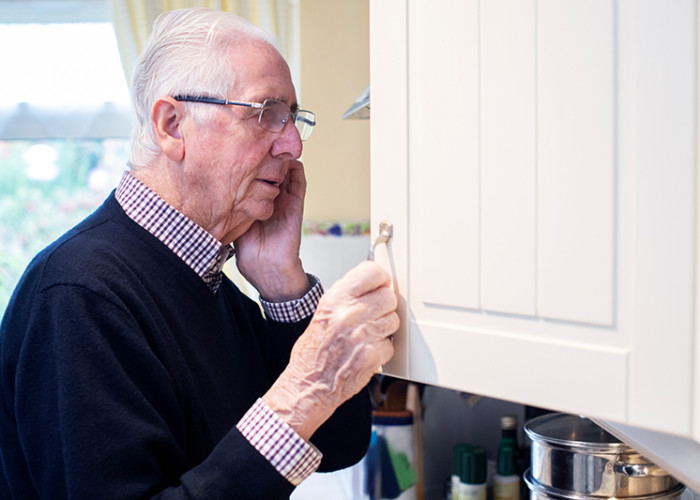
Try these tips for rummaging behaviors in dementia.
Digging through boxes, cabinets, and closets, taking out assorted items from drawers, and searching repetitively through a number of items may be frustrating for the people providing care for a loved one with Alzheimer’s, but in fact these actions are fulfilling a purpose. Rummaging behaviors in dementia can provide a degree of reassurance, along with the comfort of identifying familiar items and finding purpose and meaning.
The important thing then is not to discourage rummaging, which might lead to agitation, but to more effectively manage this behavior if it becomes disruptive.
How Can You Help Someone with Dementia with Rummaging Behaviors?
These guidelines will help:
Keep rummaging to a controlled area. Assemble bins of items the senior seems especially interested in, such as keys, paperwork, a billfold, tools, gardening equipment, sewing … Read More »
How to Tell if It’s Delirium or Dementia

Learn whether a senior may be experiencing delirium or dementia, and how you can help.
Although dementia takes center stage in diagnoses for older individuals who are struggling with confusion, memory lapses, and disorientation, there’s another condition that is also common, producing similar symptoms, and most importantly, can be cured: delirium. In fact, as many as ¾ of older adults experience delirium after a surgical procedure or infection, and proper diagnosis is crucial to ensure proper treatment. So how can you tell if it’s delirium or dementia impacting someone you love?
One of the biggest differentiators in delirium is that it arises quite suddenly. It also has a tendency to cause symptoms that come and go throughout the day, as opposed to dementia’s slow, steady, ongoing, and rather predictable progression. For example, a person with delirium may struggle … Read More »
4 Important Facts About Cancer You May Not Know

These facts about cancer may change the way you think about the disease.
Each year since 1999, we’ve achieved an increasing decline in cancer-related deaths, an encouraging trend that’s poised to continue as researchers learn more and more facts about cancer and its causes, and are able to develop new and better treatment methods. Yet cancer is still one of the leading causes of death in America, second only to heart disease – making it all the more crucial to continue to press forward with persistence to find a cure.
Here’s what we’ve learned so far:
Diet makes a difference. Although a diet rich in antioxidants can help prevent cell damage (and protect against cancer), a recent study showed that in some cases, cancers take advantage of a nutrient-rich diet, leading to accelerated metastasis. As a result, the recommendation … Read More »